The Kennedy Classes were devised by Dr Edward Kennedy in New York circa 1925 for grouping partially edentulous patients. This aids clinicians with the design of a prosthesis.
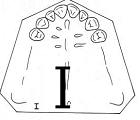
Class I – No posterior teeth- 2 free end saddles, no bounded saddles
‘Bilateral free-end saddles’
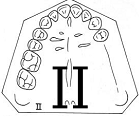
Class II – No posterior teeth on one side only – 1 free end saddle, no bounded saddles
‘Unilateral edentulous area posterior to the remaining natural teeth’
‘Unilateral free-end saddle’
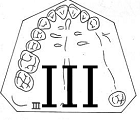
Class III – Some teeth missing on one side – No free end saddles, 1 bounded saddle
‘Unilateral edentulous area with natural teeth anterior and posterior to it’
‘Unilateral bounded posterior saddle’
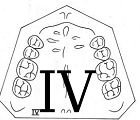
Class IV – Front teeth missing across the midline, 1 bounded saddle, no modifications
‘Single, bilateral (crossing the midline) edentulous area anterior to the remaining natural teeth’
‘Single, anterior bounded saddle’
Kennedy’s Classification modification
If there are further edentulous areas then a modification can be assigned as follows:
For one further edentulous area – Modification 1 is assigned
For two further edentulous areas – Modification 2 is assigned
This is applicable only for Classes I,II,III as further edentulous areas to Class IV will result in the creation of a Class I, II or III.
Applegate’s Classification Additions
The Kennedy Classes were added to by Dr. Oliver C. Applegate circa 1960. taking into account the condition of abutments.
Class V – An edentulous area bounded anteriorly and posteriorly by natural teeth but the anterior abutment is unsuitable for use – e.g. its is too weak. This can be considered a modification of a Class III
Class VI – An edentulous area in which the teeth adjacent to the space are capable of total support of the required prosthesis e.g. a bridge
Applegate also proposed eight rules to help aid use of Kennedy’s Classification
- All necessary extractions are completed before applying the classification
- 3rd molars are not included if they are missing and not to be replaced
- 3rd molars are included if they are present and to be used as an abutment
- 2nd molars are not included if they are missing and not to be replaced
- The most posterior edentulous area/s always determine the classification
- Edentulous areas other than those determining the classification are referred as modifications and are designated by their number
- The extent of the modification is not considered, only the number of additional edentulous areas
- There can be no modification in class IV because any additional edentulous space will definitely be posterior to it and will determine the classification
 dentalsmackers